top of page
Team Stories
Finding Inspiration in Every Turn
From England to Australia to the USA, our international team have a variety of stories and experiences making up their MRKH journey. Navigating a life with MRKH can be unbelievably tough, and this can be influenced by your culture, age, location and so much more. Get to know our team below, and the huge range of stories we all have!
Our Stories
Click the photo of a team member to read their story!

Gracie Cosman
My MRKH Journey: From Pain to Purpose
When I was 11 years old, I began experiencing major pain in
my lower abdomen—pain that eventually led my family and me down a path we never
expected. After urgent care and emergency room visits, doctors pushed for immediate
surgery. But my mom had a gut feeling that something wasn’t right and took me
to see a specialized gynecologist instead. That decision changed everything.
During the summer, I learned that I was born with a rare
condition called MRKH. I was told I had a uterus and ovaries, but I did not have a vagina or a cervix. It was a lot to take in at such a young age. I remember sitting through a virtual Zoom appointment, hoping for answers, only
to be told there were no options for me. The doctor later turned out to be dishonest with us. That betrayal left me confused, angry, and devastated.
Since then, I’ve been on birth control to help manage symptoms, but the emotional and physical pain hasn’t gone away. Recently, those same aches I felt at the beginning returned. I’m now preparing to see a new
specialist, hoping for real answers and support.
Mentally, this journey has been exhausting. For years, I carried intense shame and confusion. Talking about MRKH makes me emotional; I cry often, and opening up is hard. When I tried to share my feelings with my
mom, I was told to be grateful for what I have and to "grow up." That
response made me feel even more isolated. Still, she encouraged me to reach
out—and that’s what led me here.
I haven’t yet begun any form of dilation or vaginal lengthening, and I’m still figuring out what that part of my journey will look
like. But the real turning point for me was discovering the MRKH community. It was like taking a breath for the first time in years. Finally, I found people
who got it—who understood the pain, confusion, and strength that comes with living with MRKH.
Joining Stars was one of the most empowering decisions I’ve made. I became a Protostars Captain and a Shooting Stars Buddy
Helper, and being part of this community has helped me begin healing. It gave
me purpose and reminded me that I’m not alone in this. Through Stars, I’ve met
incredible people who inspire me daily with their vulnerability, strength, and
authenticity. It feels good to support others and be supported in return.
Right now, I’m still on my MRKH journey. There are a lot of
unknowns, but I’ve learned to take it day by day. I’m slowly learning to
forgive myself for feeling ashamed and to turn that pain into something powerful. Advocacy is becoming part of who I am—and not because I have all the answers, but because I know how important it is to be seen.
As for the future? I want to keep speaking up. I want to support newly diagnosed girls, to let them know they don’t have to walk this
alone. I want to keep growing with Stars and help make sure no one else is ever made to feel small for something so big.
This isn’t the end of my story—it’s just the beginning.
When I was 11 years old, I began experiencing major pain in
my lower abdomen—pain that eventually led my family and me down a path we never
expected. After urgent care and emergency room visits, doctors pushed for immediate
surgery. But my mom had a gut feeling that something wasn’t right and took me
to see a specialized gynecologist instead. That decision changed everything.
During the summer, I learned that I was born with a rare
condition called MRKH. I was told I had a uterus and ovaries, but I did not have a vagina or a cervix. It was a lot to take in at such a young age. I remember sitting through a virtual Zoom appointment, hoping for answers, only
to be told there were no options for me. The doctor later turned out to be dishonest with us. That betrayal left me confused, angry, and devastated.
Since then, I’ve been on birth control to help manage symptoms, but the emotional and physical pain hasn’t gone away. Recently, those same aches I felt at the beginning returned. I’m now preparing to see a new
specialist, hoping for real answers and support.
Mentally, this journey has been exhausting. For years, I carried intense shame and confusion. Talking about MRKH makes me emotional; I cry often, and opening up is hard. When I tried to share my feelings with my
mom, I was told to be grateful for what I have and to "grow up." That
response made me feel even more isolated. Still, she encouraged me to reach
out—and that’s what led me here.
I haven’t yet begun any form of dilation or vaginal lengthening, and I’m still figuring out what that part of my journey will look
like. But the real turning point for me was discovering the MRKH community. It was like taking a breath for the first time in years. Finally, I found people
who got it—who understood the pain, confusion, and strength that comes with living with MRKH.
Joining Stars was one of the most empowering decisions I’ve made. I became a Protostars Captain and a Shooting Stars Buddy
Helper, and being part of this community has helped me begin healing. It gave
me purpose and reminded me that I’m not alone in this. Through Stars, I’ve met
incredible people who inspire me daily with their vulnerability, strength, and
authenticity. It feels good to support others and be supported in return.
Right now, I’m still on my MRKH journey. There are a lot of
unknowns, but I’ve learned to take it day by day. I’m slowly learning to
forgive myself for feeling ashamed and to turn that pain into something powerful. Advocacy is becoming part of who I am—and not because I have all the answers, but because I know how important it is to be seen.
As for the future? I want to keep speaking up. I want to support newly diagnosed girls, to let them know they don’t have to walk this
alone. I want to keep growing with Stars and help make sure no one else is ever made to feel small for something so big.
This isn’t the end of my story—it’s just the beginning.

Isa Larnert
It all started in the summer of 2015. My mum asked me if I had started my period. My response was ”No!”. My mum wanted to check it up but I brushed it off due to an hectic spring and I wanted to wait. In November or December there still was no sign of it and my mum made sure that I got to go to the Gynaecologist. In January I got my diagnosis of MRKH. But I didn’t get a name for it until spring of 2021 through TikTok.
I was very broken for a period of time. I have been very insecure, I still have insecurities due to MRKH. I cried a lot and I felt like I wasn’t enough. I was in a very dark place and I almost thought of quitting and just giving up.
Then I found the community and it helped me a lot.
I have the tools for dilation but I haven’t started doing it yet. When I got the tools they didn’t help me to start or show me how to do it. I find it painful. I find it hard to go through with it. Maybe one day I will but I am not sure when.
I have two supporters in the community, they are Claire and Aysha. They are both a part of Stars. They are two amazing.
My advocating story started with Instagram. Where I started posting drawings and writing things about MRKH and about my journey with MRKH.
A few years ago I joined the Stars community. I joined because I wanted to take my advocacy to another level and help others with MRKHers.
It has been quite a journey. But I love it. I have learned a lot about myself, about MRKH and about how MRKH can come to affect us (both similar and different).
I am part of Rising Stars, a trustee and a buddy. I love it, it is so much fun with both writing prompts and having connected with so many others with MRKH. It is so much fun and it helps me to develop in so many ways.
I have come a long way. I have come to accept that I will never have a period or be able to get pregnant. I still have days where I’m insecure about myself and my body. But it is a lot less than how it was before. I find it easier to talk about my MRKH diagnosis with others than when I was younger.
I don’t think I will have children. I think I will be focus on other things in life. I plan on continue with advocating about MRKH.
I was very broken for a period of time. I have been very insecure, I still have insecurities due to MRKH. I cried a lot and I felt like I wasn’t enough. I was in a very dark place and I almost thought of quitting and just giving up.
Then I found the community and it helped me a lot.
I have the tools for dilation but I haven’t started doing it yet. When I got the tools they didn’t help me to start or show me how to do it. I find it painful. I find it hard to go through with it. Maybe one day I will but I am not sure when.
I have two supporters in the community, they are Claire and Aysha. They are both a part of Stars. They are two amazing.
My advocating story started with Instagram. Where I started posting drawings and writing things about MRKH and about my journey with MRKH.
A few years ago I joined the Stars community. I joined because I wanted to take my advocacy to another level and help others with MRKHers.
It has been quite a journey. But I love it. I have learned a lot about myself, about MRKH and about how MRKH can come to affect us (both similar and different).
I am part of Rising Stars, a trustee and a buddy. I love it, it is so much fun with both writing prompts and having connected with so many others with MRKH. It is so much fun and it helps me to develop in so many ways.
I have come a long way. I have come to accept that I will never have a period or be able to get pregnant. I still have days where I’m insecure about myself and my body. But it is a lot less than how it was before. I find it easier to talk about my MRKH diagnosis with others than when I was younger.
I don’t think I will have children. I think I will be focus on other things in life. I plan on continue with advocating about MRKH.

Jamie Neale

Julianna Wiecek

Kayley-Beaux Simmons

Madison Price

Lily Wright

Mike Lane

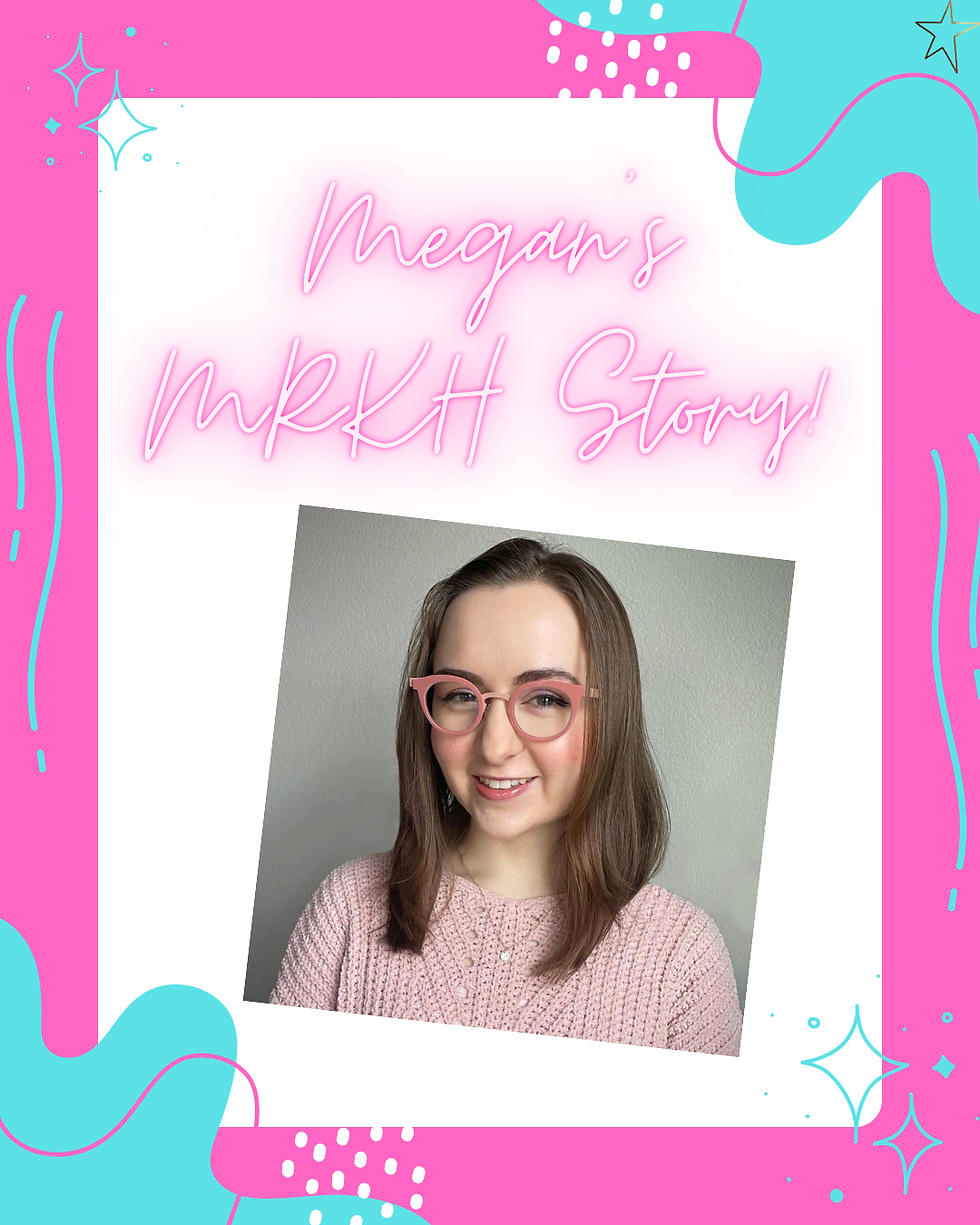
Megan Westphal
I remember being a little girl playing with my baby dolls and thinking about how one day
I would be a mother. I went through adolescence, waiting for the day my period would
begin. As the time passed with no sign of a period yet normal hormones, my doctor
placed an order for an ultrasound, followed by an MRI.
The MRI was scheduled for an early morning. The two hours of travel to the hospital
went quickly as I worried about what the MRI would reveal. I was scared and anxious,
doing all I could to stay calm. After the MRI, I nervously waited for a follow-up
appointment with a gynecologist the same day.
Then, after only a matter of hours, it felt like the world came crashing down.
M-R-K-H. Four little letters that changed my life in an instant. I remember how my body
felt in the moment the gynecologist told me that I had MRKH that day. Shock and
sadness overwhelmed me, accompanied by feelings of confusion and uncertainty. What
does it mean that I have no uterus? What did this mean for my future? Am I worthy as a
woman if I don’t have a womb? Am I worthy as a person? Am I enough?
My mind could not keep up.
Newly diagnosed during a short holiday, I returned to my university classes. I did not
feel comfortable telling anyone about my diagnosis. I felt ashamed and alone, but I also
needed time to process. I journaled in the night and cried in my empty dorm room
during the day, hoping no roommates would come in. After holding myself together
around others, I needed these moments to release the deep grief that filled my body.
Eventually, I shared about my diagnosis with a few close friends in my own time. I found
that my story was met with support and love, although I was nervous about sharing this
part of my story. And yet, deep down inside of me, I still felt like I was somehow never
going to be enough.
My mental health took a turn as I thought that changing my body would somehow help
me feel better about myself. I just wanted to feel like I was enough. Eventually, with help
and support (and tears and lots of ups and downs), I realized trying to change myself
actually caused me to feel worse about myself and my body. There is no shame in
asking for help. Sometimes asking for support can be difficult, but it is one of the bravest
things a person can do. I needed this help to get back to who I am. To the girl with the
sparkle in her eyes. To live life again.
With time, I realized that I have always and will forever be enough. It does not always
feel like it, but whether I have MRKH or not does not determine whether I am worthy.
Simply by being human, we are all enough. I have learned to be kinder to myself and
kinder to my body. To know that I do not need to change myself. To know that I am
loved no matter what. That to live fully and authentically as me is the most important
thing in the world.
I remember the day I decided to attend an MRKH Connect event, where I virtually met
other MRKHers for the first time. While I had watched a virtual MRKH conference
before, talking together felt different. Then, I experienced my first in-person MRKH
conference. I was excited and anxious, but meeting everyone while being in the same
room felt surreal. And I felt less alone. I felt connected and a part of this beautiful MRKH
community.
In January 2024, I saw a post about MRKH Stars hoping to include more individuals on
their team. I reached out. I was nervous, but I felt ready. After becoming a part of MRKH
Stars as a writer on the Rising Stars team, I found myself enjoying how writing provided
me a place to share my story and process my diagnosis in new ways that I never knew I
needed. Eventually, I became the Advocacy Coordinator and have enjoyed writing and
organizing prompts for each of our teams since then. Starting Galaxies, an art-based
team at MRKH Stars, was meaningful for me since I have always found myself using art
to process my feelings. I was happy to hear that others were interested in being part of
this team as well.
There are many things about the future and MRKH that feel uncertain. The grief from
MRKH ebbs and flows and changes with life’s natural twists and turns. I am accepting
where I am, knowing that choices about whether to have children someday, dilation,
surgery, etc., are fully my decisions. Even defining the relationship I have with my
diagnosis of MRKH is a choice completely up to me. I need to follow my values and do
what is best for me. These are decisions that I can make for myself and should never be
for anyone else. I can take my time and not rush the process. I want to respect and
honor my body and mind, wherever I find myself in the future.
And while the future is uncertain, there is one thing I now know for sure:
I am loved, worthy, and enough just as I am. And so are you. <3
I would be a mother. I went through adolescence, waiting for the day my period would
begin. As the time passed with no sign of a period yet normal hormones, my doctor
placed an order for an ultrasound, followed by an MRI.
The MRI was scheduled for an early morning. The two hours of travel to the hospital
went quickly as I worried about what the MRI would reveal. I was scared and anxious,
doing all I could to stay calm. After the MRI, I nervously waited for a follow-up
appointment with a gynecologist the same day.
Then, after only a matter of hours, it felt like the world came crashing down.
M-R-K-H. Four little letters that changed my life in an instant. I remember how my body
felt in the moment the gynecologist told me that I had MRKH that day. Shock and
sadness overwhelmed me, accompanied by feelings of confusion and uncertainty. What
does it mean that I have no uterus? What did this mean for my future? Am I worthy as a
woman if I don’t have a womb? Am I worthy as a person? Am I enough?
My mind could not keep up.
Newly diagnosed during a short holiday, I returned to my university classes. I did not
feel comfortable telling anyone about my diagnosis. I felt ashamed and alone, but I also
needed time to process. I journaled in the night and cried in my empty dorm room
during the day, hoping no roommates would come in. After holding myself together
around others, I needed these moments to release the deep grief that filled my body.
Eventually, I shared about my diagnosis with a few close friends in my own time. I found
that my story was met with support and love, although I was nervous about sharing this
part of my story. And yet, deep down inside of me, I still felt like I was somehow never
going to be enough.
My mental health took a turn as I thought that changing my body would somehow help
me feel better about myself. I just wanted to feel like I was enough. Eventually, with help
and support (and tears and lots of ups and downs), I realized trying to change myself
actually caused me to feel worse about myself and my body. There is no shame in
asking for help. Sometimes asking for support can be difficult, but it is one of the bravest
things a person can do. I needed this help to get back to who I am. To the girl with the
sparkle in her eyes. To live life again.
With time, I realized that I have always and will forever be enough. It does not always
feel like it, but whether I have MRKH or not does not determine whether I am worthy.
Simply by being human, we are all enough. I have learned to be kinder to myself and
kinder to my body. To know that I do not need to change myself. To know that I am
loved no matter what. That to live fully and authentically as me is the most important
thing in the world.
I remember the day I decided to attend an MRKH Connect event, where I virtually met
other MRKHers for the first time. While I had watched a virtual MRKH conference
before, talking together felt different. Then, I experienced my first in-person MRKH
conference. I was excited and anxious, but meeting everyone while being in the same
room felt surreal. And I felt less alone. I felt connected and a part of this beautiful MRKH
community.
In January 2024, I saw a post about MRKH Stars hoping to include more individuals on
their team. I reached out. I was nervous, but I felt ready. After becoming a part of MRKH
Stars as a writer on the Rising Stars team, I found myself enjoying how writing provided
me a place to share my story and process my diagnosis in new ways that I never knew I
needed. Eventually, I became the Advocacy Coordinator and have enjoyed writing and
organizing prompts for each of our teams since then. Starting Galaxies, an art-based
team at MRKH Stars, was meaningful for me since I have always found myself using art
to process my feelings. I was happy to hear that others were interested in being part of
this team as well.
There are many things about the future and MRKH that feel uncertain. The grief from
MRKH ebbs and flows and changes with life’s natural twists and turns. I am accepting
where I am, knowing that choices about whether to have children someday, dilation,
surgery, etc., are fully my decisions. Even defining the relationship I have with my
diagnosis of MRKH is a choice completely up to me. I need to follow my values and do
what is best for me. These are decisions that I can make for myself and should never be
for anyone else. I can take my time and not rush the process. I want to respect and
honor my body and mind, wherever I find myself in the future.
And while the future is uncertain, there is one thing I now know for sure:
I am loved, worthy, and enough just as I am. And so are you. <3

Olivia Dell'Aglio
My entire life, I have struggled with anxiety. It’s actually what led me to my diagnosis. At the age of 14, I still hadn’t gotten my period. My mom said she was a “late bloomer”, and got her period at 16, and that stuff is genetic. All of my friends at school were starting their periods while I wasn’t. My anxiety caused me to spiral when I saw a video on TikTok. The video was of a girl with text above her that said “Not getting my period at the age of 13” and next “The doctor telling me I didn’t have a uterus”. When I saw this video, I started to get anxious that I, too, didn’t have a uterus. I would go to therapy and cry, knowing it was silly and probably impossible. I told my mom and she would say “Oh stop!” or “That’s silly”. My therapist advised her to take me to an ultrasound, just so that I could see that my uterus was there and put my anxiety to rest. Obviously, it didn’t happen that way.
At my first ultrasound, several technicians had to come look at the images. They told me “my uterus was probably just tilted back” and it was probably still there. My mom got a call from the radiologist, who said we should get an MRI for more conclusive results. I did the MRI, and my mom sat me down a few days later to tell me that they couldn’t find my uterus. I was in shock, devastated. I had always dreamed of being pregnant, stuffing pillows up my shirt when I was younger. I was the girl with all of the baby dolls and every accessory. All of these dreams I had for my future were shattered.
I saw my first specialist in the spring of 2021 in New York City. SHe formally diagnosed me with MRKH, and gave me the names for several support groups. However, this doctor advised me against telling anyone about my diagnosis. This made me feel shame and embarrassment surrounding it. On one of those support groups I met Baleigh, another girl my age (who actually is another writer for Stars!), who was also newly diagnosed. We hit it off immediately, and despite living over 10 hours from one another, still speak every day.
When I was ready to start dilating that winter, my mom took me to Boston to see Dr. Laufer. His team made it clear to me that my MRKH was my story, and I could share it with whoever I felt I wanted to. This was the beginning of me accepting my diagnosis.
A huge turning point for me was in November of 2022 when I took part in an MRKH documentary. 15 women from all over the country of all different ages and backgrounds were chosen and brought together in a New York City film studio. I was lucky enough to be one of them, and so was Baleigh. We met for the first time in person that fall, and it was amazing. When I sat in the hair and makeup chair for the shoot, I had a moment of realization. What was I doing? I started to regret coming at all. I feared people in my life finding out about my condition and treating me differently for it. However, all of that fear washed away when I heard the stories of the 14 other women around me. It was such an emotional day and so rewarding. After hearing the stories of these women, I had a newfound passion for advocacy and sharing my story with the world.
One of the most powerful things about this day was the end. I’ll never forget the tears that were shed during the shoot, however the ones after were the most powerful. One of the men who was controlling the microphones just started crying. He was amazed by the strength, community, and power that radiated in that room. “You guys are warriors”. Those 4 words continue to impact me to this day. Not only does our own community see us as strong, but the rest of the world does too.
That day is the reason why I’m here, writing this piece. I am so grateful to be a part of MRKH Stars and helping girls through their diagnosis. This passion solidified my interest in pursuing healthcare in my future. I want to become a doctor and help girls like me. I wish I had someone to tell me that everything was going to be ok. I felt so alone and isolated during the first few months, and I never want anyone to feel like that. There is such a large community of strong, MRKH girls with an unbreakable connection to one another. You are never alone.
At my first ultrasound, several technicians had to come look at the images. They told me “my uterus was probably just tilted back” and it was probably still there. My mom got a call from the radiologist, who said we should get an MRI for more conclusive results. I did the MRI, and my mom sat me down a few days later to tell me that they couldn’t find my uterus. I was in shock, devastated. I had always dreamed of being pregnant, stuffing pillows up my shirt when I was younger. I was the girl with all of the baby dolls and every accessory. All of these dreams I had for my future were shattered.
I saw my first specialist in the spring of 2021 in New York City. SHe formally diagnosed me with MRKH, and gave me the names for several support groups. However, this doctor advised me against telling anyone about my diagnosis. This made me feel shame and embarrassment surrounding it. On one of those support groups I met Baleigh, another girl my age (who actually is another writer for Stars!), who was also newly diagnosed. We hit it off immediately, and despite living over 10 hours from one another, still speak every day.
When I was ready to start dilating that winter, my mom took me to Boston to see Dr. Laufer. His team made it clear to me that my MRKH was my story, and I could share it with whoever I felt I wanted to. This was the beginning of me accepting my diagnosis.
A huge turning point for me was in November of 2022 when I took part in an MRKH documentary. 15 women from all over the country of all different ages and backgrounds were chosen and brought together in a New York City film studio. I was lucky enough to be one of them, and so was Baleigh. We met for the first time in person that fall, and it was amazing. When I sat in the hair and makeup chair for the shoot, I had a moment of realization. What was I doing? I started to regret coming at all. I feared people in my life finding out about my condition and treating me differently for it. However, all of that fear washed away when I heard the stories of the 14 other women around me. It was such an emotional day and so rewarding. After hearing the stories of these women, I had a newfound passion for advocacy and sharing my story with the world.
One of the most powerful things about this day was the end. I’ll never forget the tears that were shed during the shoot, however the ones after were the most powerful. One of the men who was controlling the microphones just started crying. He was amazed by the strength, community, and power that radiated in that room. “You guys are warriors”. Those 4 words continue to impact me to this day. Not only does our own community see us as strong, but the rest of the world does too.
That day is the reason why I’m here, writing this piece. I am so grateful to be a part of MRKH Stars and helping girls through their diagnosis. This passion solidified my interest in pursuing healthcare in my future. I want to become a doctor and help girls like me. I wish I had someone to tell me that everything was going to be ok. I felt so alone and isolated during the first few months, and I never want anyone to feel like that. There is such a large community of strong, MRKH girls with an unbreakable connection to one another. You are never alone.

Pranavi Tiru

Rose Mina O'Donnell

Sydney Scaddan

Tk Kennedy
When I was 16 I went to the doctors because I still hadn’t started my period and was told I was a late bloomer and sent on my way. I went back when I was 17 and said I still haven’t started, and they suggested that maybe I had PCOS so they sent me for a blood test. The blood test came back normal so they sent me for a Ultrasound. After about 30 minutes of lying there, the doctor said: “Maybe you just don’t have a womb.” I was absolutely shocked. I just kept thinking you can’t be born without a womb. As soon as I got home I googled it and came across MRKH. The more I looked into MRKH the more everything made sense about my body. I also found out then about MRKH’s effect on fertility. The next week I was booked in for an emergency Ultrasound because this time he wanted to have a good search for my womb. He still found nothing, so that afternoon I had to go back to my GP, who sent me to see a private gynaecologist 4 months later, who internally examined me and suggested I had MRKH. That afternoon I cried non-stop because there was actually a possibility of me not being able to get pregnant and carry my child. The next week I had an MRI scan which wasn’t fun. A week later they diagnosed me with MRKH and I couldn’t even cry as I was so in shock. That day it felt like I was starting a “new life”.
I had a lot of thoughts and feelings towards MRKH - it was such a roller coaster and still is today to be honest. Some days were good, others were bad and really low. I had times where I struggled to see the point of being here, but giving in would mean that MRKH had won and I knew from the beginning that I was stronger than my diagnosis.
Pretty quickly after being diagnosed, I was referred to Queen Charlotte’s, met the hospital team and started therapy. It wasn’t until a year later that I reached out and found the community of MRKHers. I posted parts of my MRKH story on instagram and was found by producers who wanted to record a day in my life. I turned them down, but a week later Vics messaged me asking me to join Stars back in May 2021. Since then I have found so many amazing friends in the amazing MRKH community and Vics has become my partner in crime. In July I became the “Second Star” of Stars. Then in October I became joint Co-Director of Stars with Vics. I joined Stars because I knew what it was like for me to have no one to connect with, to be walking a similar journey to me not so long ago. I wanted to be there for newly diagnosed MRKHers. Also I had never heard of MRKH pre-diagnosis, so I wanted to help spread as much awareness of MRKH as I could, so others can be educated that there is a diagnosis like this out here.
I currently run the Shooting Stars scheme, introducing MRKHers to mentors so they don’t have to feel alone. I love being able to connect others together and help other Warriors as they start their journey. I have such an amazing support group from not only the girls on Stars but from others within the MRKH community. Most of all Vics - she is always there for me just a phone call away who I can and have gone to about anything big or small.
At the moment I’m back on the waiting list to start dilation, after been given dates to start three times and Covid complicating things further. I’m not seeing my therapist at the moment and am having a break while I’m in a good place with MRKH. I’m enjoying sharing my experience and reminding others that they don’t need to go through this alone and there can be positives to this diagnosis.
My future plans are to begin dilation and to be able to grow stars even more with Vics. And maybe even to find some more exciting project to spread awareness and help others through their journey. For me personally, I want to live a happy life and find ways to overcome the troubles and challenges that MRKH can bring. I don’t want MRKH to affect all of the future plans I had pre-diagnosis, even though I understand some of those plans may need adapting.
“Smooth seas do not make Skilful sailors.”
I had a lot of thoughts and feelings towards MRKH - it was such a roller coaster and still is today to be honest. Some days were good, others were bad and really low. I had times where I struggled to see the point of being here, but giving in would mean that MRKH had won and I knew from the beginning that I was stronger than my diagnosis.
Pretty quickly after being diagnosed, I was referred to Queen Charlotte’s, met the hospital team and started therapy. It wasn’t until a year later that I reached out and found the community of MRKHers. I posted parts of my MRKH story on instagram and was found by producers who wanted to record a day in my life. I turned them down, but a week later Vics messaged me asking me to join Stars back in May 2021. Since then I have found so many amazing friends in the amazing MRKH community and Vics has become my partner in crime. In July I became the “Second Star” of Stars. Then in October I became joint Co-Director of Stars with Vics. I joined Stars because I knew what it was like for me to have no one to connect with, to be walking a similar journey to me not so long ago. I wanted to be there for newly diagnosed MRKHers. Also I had never heard of MRKH pre-diagnosis, so I wanted to help spread as much awareness of MRKH as I could, so others can be educated that there is a diagnosis like this out here.
I currently run the Shooting Stars scheme, introducing MRKHers to mentors so they don’t have to feel alone. I love being able to connect others together and help other Warriors as they start their journey. I have such an amazing support group from not only the girls on Stars but from others within the MRKH community. Most of all Vics - she is always there for me just a phone call away who I can and have gone to about anything big or small.
At the moment I’m back on the waiting list to start dilation, after been given dates to start three times and Covid complicating things further. I’m not seeing my therapist at the moment and am having a break while I’m in a good place with MRKH. I’m enjoying sharing my experience and reminding others that they don’t need to go through this alone and there can be positives to this diagnosis.
My future plans are to begin dilation and to be able to grow stars even more with Vics. And maybe even to find some more exciting project to spread awareness and help others through their journey. For me personally, I want to live a happy life and find ways to overcome the troubles and challenges that MRKH can bring. I don’t want MRKH to affect all of the future plans I had pre-diagnosis, even though I understand some of those plans may need adapting.
“Smooth seas do not make Skilful sailors.”

Vics Lane
I’m Vics, and I’m the Founder and Co-Director of MRKH Stars.
I live with a condition called MRKH Syndrome, like most of our team do, but I didn’t always know I had the condition; I was diagnosed in 2019, when I was 17.
My journey to diagnosis was far from straightforward, it started off with a GP visit just after my 17th birthday because I hadn’t started my period. The GP ordered blood tests, then an ultrasound. The results of the ultrasound appeared to show that I had no womb, and no ovaries; this was wrong, but at the time I didn’t know that.
I was scared after those results. We were then told we would be waiting months before finding out anymore. So, we decided to switch from seeking answers with the NHS to meeting with a private consultant, and the whole process was sped up from there.
My mum and I met with her, and she ordered more tests. This time: an MRI, more blood tests, and a meeting with an endocrinologist (a hormone specialist). He then asked for the MRI to be conducted on my brain as well as my pelvic area and, of course, more blood tests.
After going through all that, and then the month long waiting period for results, I was diagnosed with MRKH on the 11th July 2019.
Initially, I felt so confused. I didn’t understand how I could be so unlucky. My whole life changed in that moment when I was diagnosed. I screamed, I cried and I completely lost myself.
The first 18 months after receiving my diagnosis I was a mess and faced some serious battles; some with my physical health, others with my mental health. This diagnosis tested me in every way imaginable, and in some ways now, it still does.
I was at my lowest from September-December 2020. It was a truly difficult time for me. I had just moved to university, which me really struggle with my MRKH diagnosis. I naively thought that I could leave my MRKH life behind me when I moved. I wanted uni to be a place where I could start fresh. I wanted to settle with that big change without the fear of my diagnosis getting in the way of my new life. I took a brief step back from advocacy, and barely spoke about my diagnosis to anyone, I even avoided it in therapy. But the pain was still there. I had moved my life to a different city, but MRKH came with me and, at the time, was an unwelcome addition to my new life.
Even before this big shift in my life, I spent a year after my diagnosis fighting through the system to desperately try and access the correct medical care. I was meeting doctor after doctor at various different hospitals feeling stuck, getting offered incorrect courses of treatment and advice. All I wanted was to be referred to the specialist team at the Queen Charlotte and Chelsea Hospital, a team I only knew about because the MRKH community led me to them. Without that influence, I probably would have been pushed into a surgery I didn’t want, long before I was ready.
The team at Queen Charlotte’s advised me that the treatment they offer (dilation) is non-surgical, less invasive than the surgery, and that there is no rush to start it. It took me around 2 years to decide to pursue dilators, and that is a part of my journey that I choose to keep private and only my closest circle know about my experiences.
It took me being in psychological therapy for well over a year to finally feel ready to start that part of my journey, after all of the trauma I faced in and around hospitals, I had a deep-rooted fear of attending appointments. It took a while to feel safe again, but I was supported by my friends and the Queen Charlotte’s team through every step and I am now able to attend appointments on my own if I need to. Had I agreed to start treatment sooner, or agreed to the surgery before I had processed all of those difficult memories, I definitely would not have been in a position to do what I do now in running MRKH Stars.
When I was first diagnosed with this condition, it was the MRKH community that saved me. They advised me on the right course of treatment and were, and are still, an incredible support to me. I have found my second family in this community: a bonus mum, some big sister role models, some younger sisters, who I now support, and some of my best and most trusted friends and confidants.
We have had teary phone calls, and sometimes we argue, but we also spend nights talking and having a few drinks, or having movie nights. Having people around you who just get it, can help you work through your trauma and difficult feelings in the correct way. With no self-destructing or bottling, we take things step by step, is so important, and we do it safely. We have been through so much together, we have become a family, and creating MRKH Stars has led me to be a changemaker up there with the amazing people who have changed my life.
This journey hasn’t been easy. My people have seen me in some of my deepest darkest moments, memories that I would give anything to be able to erase for all of us. But, in time, they only made us stronger and now, I know we can face any challenge the world throws at us.
This journey isn’t meant to be fought alone. We are here to make sure you don’t have to. Right now, I have some truly amazing people in my life, who I wouldn’t have if it wasn’t for my MRKH diagnosis. I wouldn’t be here today without this community, we support each other unconditionally, and we are here to do that for you too! X
I live with a condition called MRKH Syndrome, like most of our team do, but I didn’t always know I had the condition; I was diagnosed in 2019, when I was 17.
My journey to diagnosis was far from straightforward, it started off with a GP visit just after my 17th birthday because I hadn’t started my period. The GP ordered blood tests, then an ultrasound. The results of the ultrasound appeared to show that I had no womb, and no ovaries; this was wrong, but at the time I didn’t know that.
I was scared after those results. We were then told we would be waiting months before finding out anymore. So, we decided to switch from seeking answers with the NHS to meeting with a private consultant, and the whole process was sped up from there.
My mum and I met with her, and she ordered more tests. This time: an MRI, more blood tests, and a meeting with an endocrinologist (a hormone specialist). He then asked for the MRI to be conducted on my brain as well as my pelvic area and, of course, more blood tests.
After going through all that, and then the month long waiting period for results, I was diagnosed with MRKH on the 11th July 2019.
Initially, I felt so confused. I didn’t understand how I could be so unlucky. My whole life changed in that moment when I was diagnosed. I screamed, I cried and I completely lost myself.
The first 18 months after receiving my diagnosis I was a mess and faced some serious battles; some with my physical health, others with my mental health. This diagnosis tested me in every way imaginable, and in some ways now, it still does.
I was at my lowest from September-December 2020. It was a truly difficult time for me. I had just moved to university, which me really struggle with my MRKH diagnosis. I naively thought that I could leave my MRKH life behind me when I moved. I wanted uni to be a place where I could start fresh. I wanted to settle with that big change without the fear of my diagnosis getting in the way of my new life. I took a brief step back from advocacy, and barely spoke about my diagnosis to anyone, I even avoided it in therapy. But the pain was still there. I had moved my life to a different city, but MRKH came with me and, at the time, was an unwelcome addition to my new life.
Even before this big shift in my life, I spent a year after my diagnosis fighting through the system to desperately try and access the correct medical care. I was meeting doctor after doctor at various different hospitals feeling stuck, getting offered incorrect courses of treatment and advice. All I wanted was to be referred to the specialist team at the Queen Charlotte and Chelsea Hospital, a team I only knew about because the MRKH community led me to them. Without that influence, I probably would have been pushed into a surgery I didn’t want, long before I was ready.
The team at Queen Charlotte’s advised me that the treatment they offer (dilation) is non-surgical, less invasive than the surgery, and that there is no rush to start it. It took me around 2 years to decide to pursue dilators, and that is a part of my journey that I choose to keep private and only my closest circle know about my experiences.
It took me being in psychological therapy for well over a year to finally feel ready to start that part of my journey, after all of the trauma I faced in and around hospitals, I had a deep-rooted fear of attending appointments. It took a while to feel safe again, but I was supported by my friends and the Queen Charlotte’s team through every step and I am now able to attend appointments on my own if I need to. Had I agreed to start treatment sooner, or agreed to the surgery before I had processed all of those difficult memories, I definitely would not have been in a position to do what I do now in running MRKH Stars.
When I was first diagnosed with this condition, it was the MRKH community that saved me. They advised me on the right course of treatment and were, and are still, an incredible support to me. I have found my second family in this community: a bonus mum, some big sister role models, some younger sisters, who I now support, and some of my best and most trusted friends and confidants.
We have had teary phone calls, and sometimes we argue, but we also spend nights talking and having a few drinks, or having movie nights. Having people around you who just get it, can help you work through your trauma and difficult feelings in the correct way. With no self-destructing or bottling, we take things step by step, is so important, and we do it safely. We have been through so much together, we have become a family, and creating MRKH Stars has led me to be a changemaker up there with the amazing people who have changed my life.
This journey hasn’t been easy. My people have seen me in some of my deepest darkest moments, memories that I would give anything to be able to erase for all of us. But, in time, they only made us stronger and now, I know we can face any challenge the world throws at us.
This journey isn’t meant to be fought alone. We are here to make sure you don’t have to. Right now, I have some truly amazing people in my life, who I wouldn’t have if it wasn’t for my MRKH diagnosis. I wouldn’t be here today without this community, we support each other unconditionally, and we are here to do that for you too! X
bottom of page